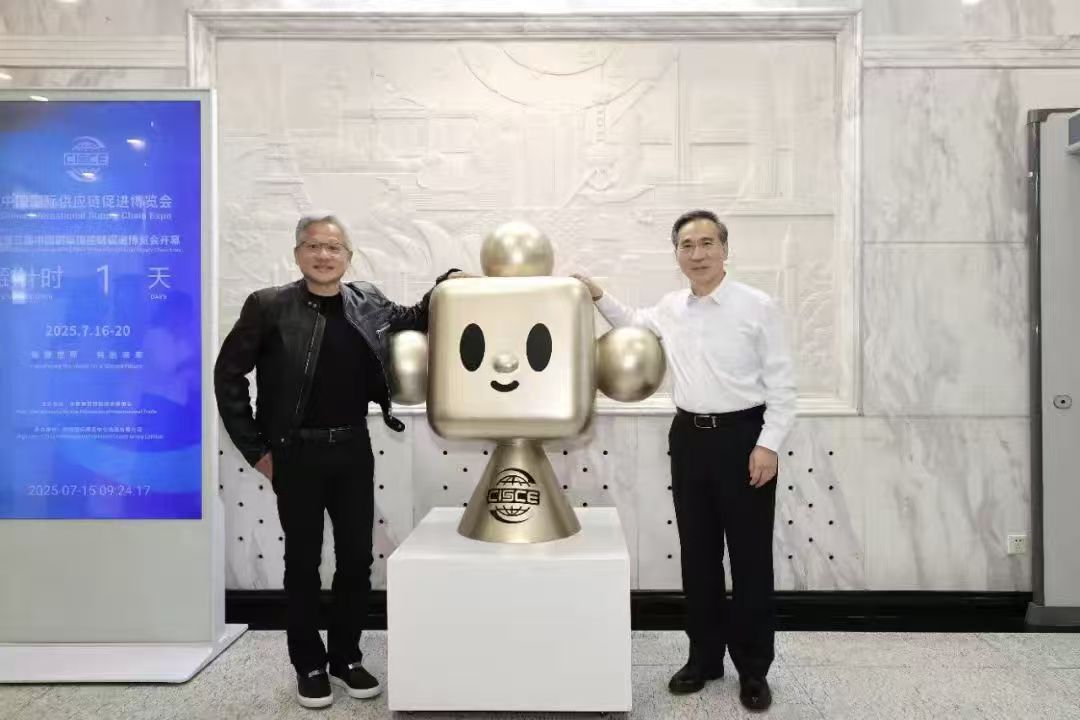
NVIDIA Founder Highlights Interconnectivity as Key to Industry Evolution at Supply Chain Expo
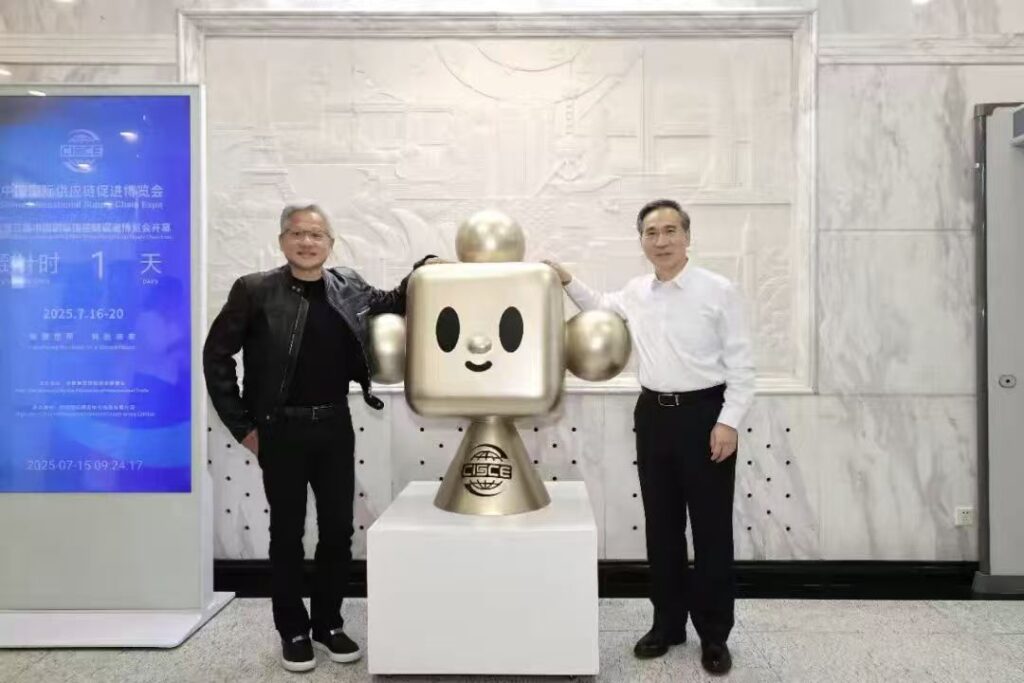
Beijing, July 20, 2025 – At the opening ceremony of the China International Supply Chain Expo (CISE) on July 16th, NVIDIA founder and CEO Jensen Huang, donning a traditional Tang suit, delivered significant insights on global technology ecosystems and China’s pivotal role. Huang emphasized that the “interconnectivity of technology ecosystems has become a critical issue for industrial evolution.”
Huang shared two key observations from his visit:
- China’s Advanced Supply Chain: He expressed deep admiration for China’s “highly developed supply chain, characterized by comprehensive infrastructure, a mature ecosystem, advanced technology, and vast manufacturing scale.”
- Global Interdependence: The diverse range of global exhibitors at the Expo vividly demonstrated the “highly interdependent nature of global supply chains.”
Core Perspectives from Media Exchange:
- China’s Supply Chain Foundation: Huang identified China’s “complex, efficient, and manufacturing-advantaged supply chain system” as a vital foundation for global AI hardware and smart factory construction.
- Market Commitment & Products: Confirming the renewed approval for the H20 chip, Huang stated NVIDIA would “promote the launch of more Blackwell architecture products in China.” He affirmed continuous investment in China, noting, “The market is developing rapidly, competition is exceptionally fierce… We must advance every single day to be worthy of the business we have.”
- Leadership in AI & Talent: Huang lauded China’s global leadership in “AI models, engineering talent, and industrial applications,” highlighting that “approximately 50% of the world’s AI researchers are in China,” crediting the education system for cultivating “some of the world’s finest AI researchers.”
- Praise for Chinese Innovators:
- EV Sector: He gave “extremely high praise” to Chinese automakers like Xiaomi Auto, NIO, and XPeng, calling Chinese EVs a “global surprise” and stating companies like Xiaomi are “reshaping the global competitive landscape.”
- Huawei: Huang commended Huawei for “major breakthroughs in chips, network solutions, and photonics technology,” calling it “a company worthy of learning from.”
- Lei Jun (Xiaomi): Recalling their first meeting in Beijing, Huang said, “From day one, I knew he would succeed,” praising Lei Jun’s leadership in achieving “tremendous success from smartphones to electric vehicles.” He was particularly impressed seeing Xiaomi’s new EV Ultra version in person, calling its performance “beyond expectations.”
- AI Tool Usage: Huang revealed he uses four AI tools daily – OpenAI, Gemini Pro, Claude, and Perplexity – employing a “multi-AI comparative questioning” approach to cross-verify answers for improved accuracy and comprehensiveness.
- Advice & AGI Outlook: Encouraging young people to maintain passion for technology without fear of being “late,” Huang shared his own story of founding NVIDIA at 20, stating the “greatest fortune is doing what you love.” On AGI, he suggested it “could be achieved soon under current evaluation standards without fundamental breakthroughs,” though progress depends on its definition.
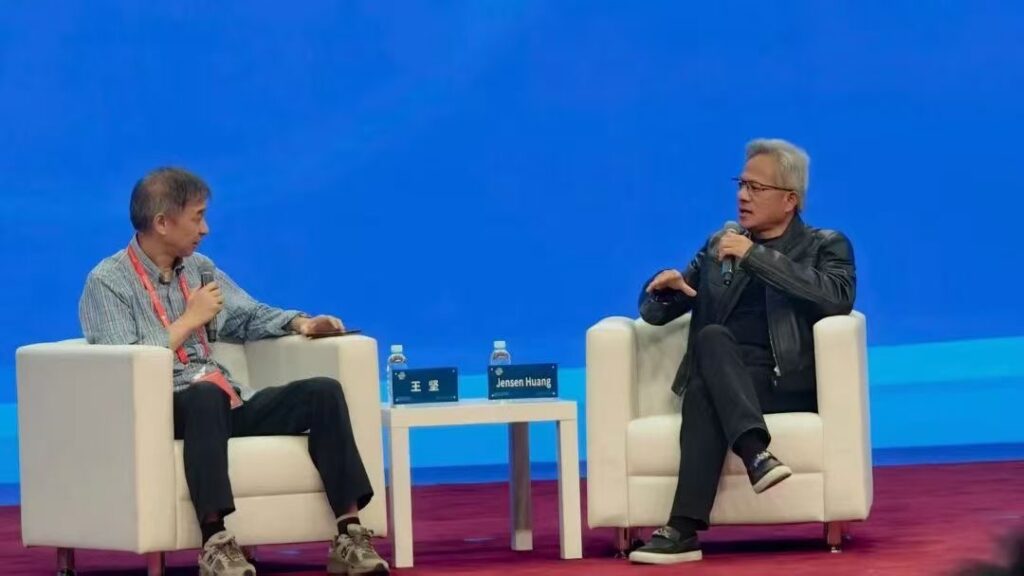
Jensen Huang’s interview at the Supply Chain Expo
Q: This is your third visit to China this year. What is your main purpose for this trip?
Jensen Huang: I was invited to attend the opening ceremony of the China International Supply Chain Expo. This event is very important and covers multiple dimensions.
First, China’s supply chain is exceptionally complex and advanced. It involves long-term collaboration and connections among numerous suppliers, capabilities, and technologies. China’s supply chain infrastructure, ecosystem, and technical proficiency are highly sophisticated, and its manufacturing scale is immense.
Second, many multinational corporations participated this year, demonstrating how deeply interdependent global supply chains are. I’m also delighted to join the opening celebrations.
Q: What are your plans next? Will NVIDIA continue collaborating with Chinese companies?
Jensen Huang: NVIDIA has been around for over 30 years. When I first came to China, companies like Baidu, Alibaba, Tencent, and Xiaomi didn’t even exist. I came early, and it’s been an honor to partner with these companies—especially when NVIDIA itself was still young. I take great pride in the technology and business we’ve created alongside our Chinese partners.
Q: Does NVIDIA still plan to invest in China, or will you maintain existing operations only?
Jensen Huang: If you want to sustain growth, you must keep investing. The market evolves so rapidly, and competition is exceptionally fierce. None of my competitors are maintaining the status quo; they’re investing relentlessly to become global leaders. We too must push forward every single day to deserve the business we have.
Jensen Huang (voluntarily added): We collaborate closely with Xiaomi across many domains. Xiaomi is a fantastic partner. When I first met Lei Jun in Beijing, he was very young—I was young too, but he was even younger. From day one, I knew he would succeed. Lei Jun has led Xiaomi to tremendous achievements—from smartphones to EVs—all worthy of high praise.
Q: What did you and Lei Jun discuss?
Jensen Huang: We talked about AI, including its latest advances in language models, autonomous driving, and robotics. As a leader with deep technical expertise and outstanding business acumen, Lei Jun’s insights were impressive. Notably, I witnessed the highly anticipated new electric car in person. Though I’d seen it online, the real experience left me deeply impressed. He enthusiastically showed me the new Ultra version—its performance exceeded all expectations.
Q: They’re also expanding into appliances like air conditioners!
Jensen Huang: Exactly! It’s incredible how much innovation they’ve built within Xiaomi’s ecosystem. Many assume China’s tech strength lies only in hardware—batteries, EVs, solar panels, materials science, even computing systems and networks.
But an underrated marvel is China’s world-class computer science and software capabilities. In the future, everything will be software-defined: hotel management systems, rice cookers, microwaves, refrigerators, washing machines—even inspection tools. My jacket should have software to cool me automatically! Every piece of clothing will have software; glasses will have software. Every company, even hardware-focused ones, will integrate software and deeply connect with the cloud.
Companies like Xiaomi, Alibaba, and Tencent uniquely blend hardware and software excellence. More people should celebrate this. Apps like ByteDance’s may seem like consumer products, but their underlying technology is extraordinarily advanced.
Q: How do you view the future of the Chinese market?
Jensen Huang: I hope to achieve great success in China. As the world’s second-largest tech market—still growing rapidly—it’s critically important. China has dynamic, innovative customers. To build a great company and deliver quality service, you need great clients and products. Here, we serve demanding customers who persistently innovate. We aim to offer them our best.
Q: What lessons can the world learn from China’s technological innovations?
Jensen Huang: China has birthed uniquely impactful innovations: WeChat, Xiaohongshu, and TikTok—which reshaped the global internet landscape. China holds distinct advantages in new application development. Here, mobile payments are ubiquitous—no wallets, cash, or credit cards needed. In the U.S., I still use bills, making me feel like a dinosaur! China leads in applied technology, especially in payment systems and fintech. The world is learning from China’s innovative practices. Companies like Xiaomi, Alibaba, and Tencent uniquely blend hardware and software excellence. More people should celebrate this. Apps like ByteDance’s may seem like consumer products, but their underlying technology is extraordinarily advanced.
Q: How do you view the future of the Chinese market?
Jensen Huang: I hope to achieve great success in China. As the world’s second-largest tech market—still growing rapidly—it’s critically important. China has dynamic, innovative customers. To build a great company and deliver quality service, you need great clients and products. Here, we serve demanding customers who persistently innovate. We aim to offer them our best.
Q: What lessons can the world learn from China’s technological innovations?
Jensen Huang: China has birthed uniquely impactful innovations: WeChat, Xiaohongshu, and TikTok—which reshaped the global internet landscape. China holds distinct advantages in new application development. Here, mobile payments are ubiquitous—no wallets, cash, or credit cards needed. In the U.S., I still use bills, making me feel like a dinosaur! China leads in applied technology, especially in payment systems and fintech. The world is learning from China’s innovative practices.
为您提供多样化全球解决方案